
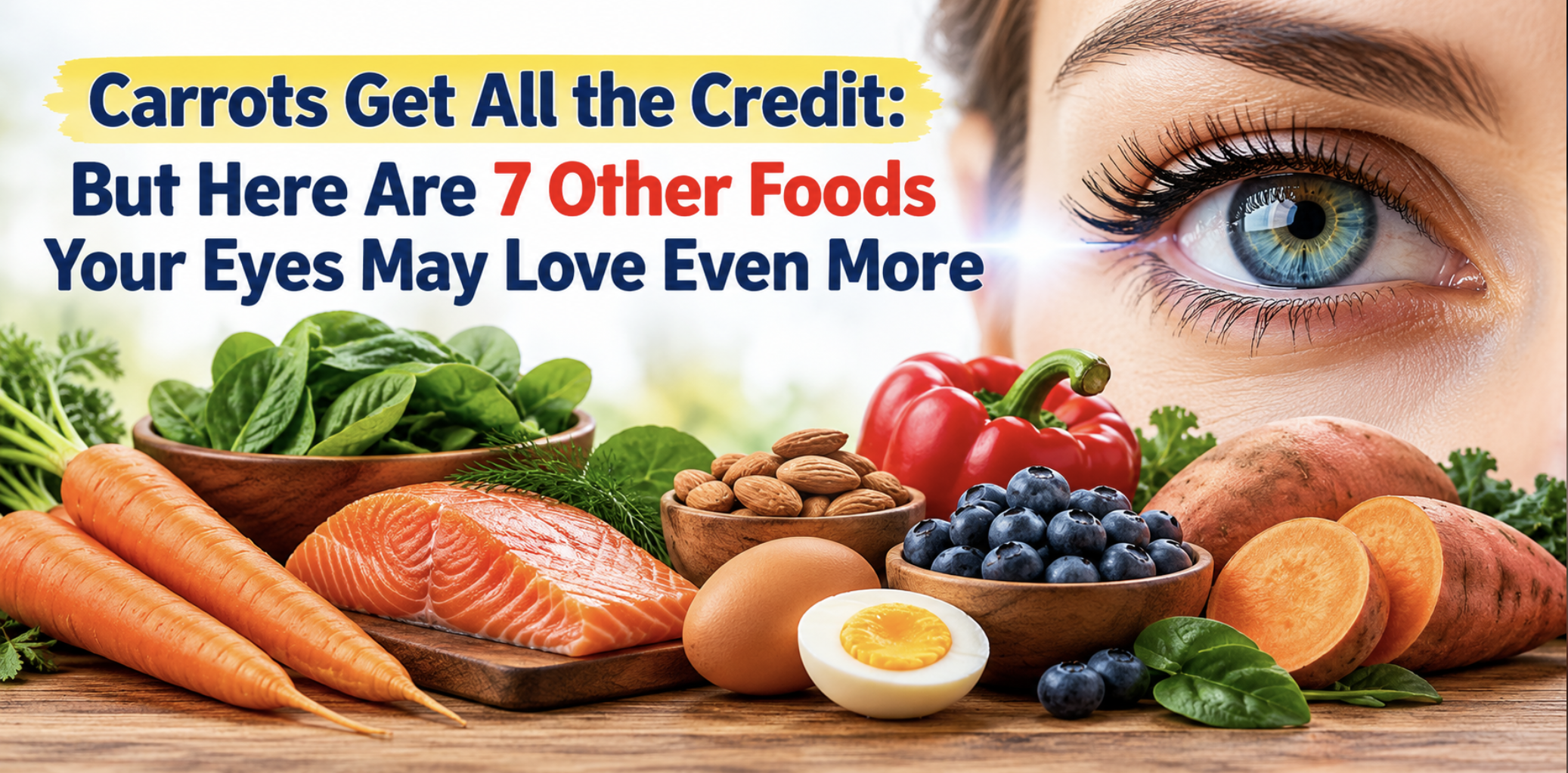
Ask someone what to eat for healthy eyes, and there’s a good chance you’ll hear one answer:
Carrots. 🥕
It’s practically been drilled into us.
Carrots = good eyesight.
And to be fair, carrots deserve some of that reputation. They contain beta-carotene, which your body can convert into vitamin A — an essential nutrient for normal vision.
But here’s the part that doesn’t get nearly as much attention:
Your eyes need more than one nutrient. And carrots are far from the only interesting food on the menu.
Your eyes are constantly dealing with light, screens, environmental exposure and the normal changes that come with getting older.
Fortunately, some surprisingly ordinary foods contain nutrients that play important roles in maintaining normal eye health.
And a few of them might surprise you.
1. Eggs: There’s Something Interesting Hiding in the Yolk 🍳
For years, the egg white seemed to get all the attention.
But when it comes to eye-friendly nutrients, don’t be so quick to throw away that yellow center.
Egg yolks contain lutein and zeaxanthin — two carotenoids found naturally in the retina, particularly in the macula.
Think of them as part of the eye’s built-in nutritional defense system.
Eggs also provide vitamin A and zinc, making the humble breakfast egg considerably more interesting for your eyes than it first appears.
The takeaway: That yolk isn’t just there for flavor.
2. Spinach: Your Eyes Have a Reason to Like Green 🥬
Carrots may have claimed orange as the unofficial color of eye health, but perhaps dark green deserves just as much attention.
Spinach is naturally rich in lutein and zeaxanthin.
And spinach isn’t alone.
Kale, collard greens and other dark leafy vegetables can provide these carotenoids too.
So if carrots aren’t exactly your favorite food, your salad bowl has plenty of alternatives.
Easy idea: Add a handful of spinach to an omelet, soup, sandwich or smoothie rather than completely changing what you eat.
3. Salmon: Your Eyes Like Healthy Fats Too 🐟
When people think about nutrition for their eyes, fat probably isn’t the first thing that comes to mind.
But certain fats are important.
Fatty fish such as salmon provide omega-3 fatty acids, including DHA.
Here’s the interesting part:
DHA is naturally present in high concentrations in the retina.
Omega-3s have therefore become an important area of research in eye nutrition.
Salmon also happens to be an easy way to get high-quality protein alongside those fats.
Not a salmon fan? Sardines, trout and mackerel are other sources of omega-3s.
4. Red Bell Peppers: The Colorful Food People Forget About 🌶️
Here’s an eye-friendly food that rarely gets invited into the conversation.
Red bell peppers.
They’re an excellent dietary source of vitamin C.
Why does that matter?
Vitamin C is an antioxidant, and the eye contains particularly high concentrations of it.
And unlike some foods that require elaborate preparation, bell peppers can simply be sliced and eaten raw, tossed into salads or added to a stir-fry.
There’s also a nice bonus:
They add a satisfying crunch without bringing many calories along with them.
5. Sweet Potatoes: Carrots Have Competition 🍠
If carrots built their reputation on beta-carotene, they might want to keep an eye on sweet potatoes.
Their bright orange color comes partly from — you guessed it — beta-carotene.
Your body can convert beta-carotene into vitamin A, which contributes to normal vision and is particularly important for seeing under low-light conditions.
And sweet potatoes are incredibly versatile.
Roasted.
Mashed.
Air-fried.
Added to soups.
Even turned into wedges.
So if your idea of “eating for your eyes” was forcing yourself through another bowl of raw carrots, consider this your permission to branch out.
6. Almonds: A Small Snack With an Interesting Nutrient 🌰
Almonds don’t look particularly exciting.
But nutritionally, they’re carrying something your eyes can use:
Vitamin E.
Vitamin E is a fat-soluble antioxidant that helps protect cells from oxidative damage.
A small handful of almonds can contribute a meaningful amount to your daily vitamin E intake.
Other sources include sunflower seeds, peanuts and hazelnuts.
Just remember that nuts are calorie-dense, so a handful is very different from absent-mindedly working your way through an entire bag.
7. Blueberries: Tiny Berries, Serious Color 🫐
Blueberries don’t contain magical eyesight powers — despite what some dramatic internet headlines might have you believe.
But they’re still worth having on the list.
Their deep blue-purple color comes from plant compounds called anthocyanins.
Blueberries also provide vitamin C and a variety of other plant compounds, which is one reason berries are often included in diets built around colorful, nutrient-rich whole foods.
And they’re ridiculously easy to add to meals.
Throw them into oatmeal.
Add them to yogurt.
Blend them into a smoothie.
Or simply eat them by the handful.
Sometimes healthy eating doesn’t need to be complicated.
So… Should We Forget About Carrots?
Not at all.
Carrots are nutritious.
They just shouldn’t have a monopoly on the eye-health conversation.
Your eyes rely on a variety of nutrients — including vitamin A, vitamin C, vitamin E, zinc, omega-3 fatty acids, lutein and zeaxanthin.
And that’s why variety matters.
Instead of searching for one “miracle food,” think in colors:
🥬 Dark greens
🍠 Orange vegetables
🌶️ Bright reds
🫐 Deep blues and purples
🐟 Omega-3-rich fish
🥚 Nutrient-rich proteins
🌰 Nuts and seeds
Your plate suddenly starts looking a lot more interesting than a lonely carrot.
One More Thing Your Eyes Would Probably Tell You…
Food is only one piece of the puzzle.
Regular comprehensive eye exams, UV protection, adequate sleep, physical activity, managing health conditions such as diabetes and giving your eyes sensible breaks during long periods of screen use all matter too.
And if you’ve noticed sudden vision changes, flashes of light, new floaters, eye pain or significant loss of vision, that’s not something to solve with spinach or supplements — get medical attention promptly.
But for everyday nutrition?
Maybe it’s finally time to let carrots share the spotlight.
Because when it comes to feeding your eyes, the most interesting plate may also be the most colorful one. 👁️🥬🫐
*ADVERTISEMENT*







Add comment